Taco Bell invoice automation
Supplier invoices into clean accounting data, on the client's own server
An invoice processing app for Siam Taco Co., Ltd., which runs Taco Bell in Thailand. Head-office staff upload scanned PDFs and photos of supplier invoices, and the app extracts every line item, discount and total, flags what it isn't sure of, and keeps everything on the company's own server.
The product
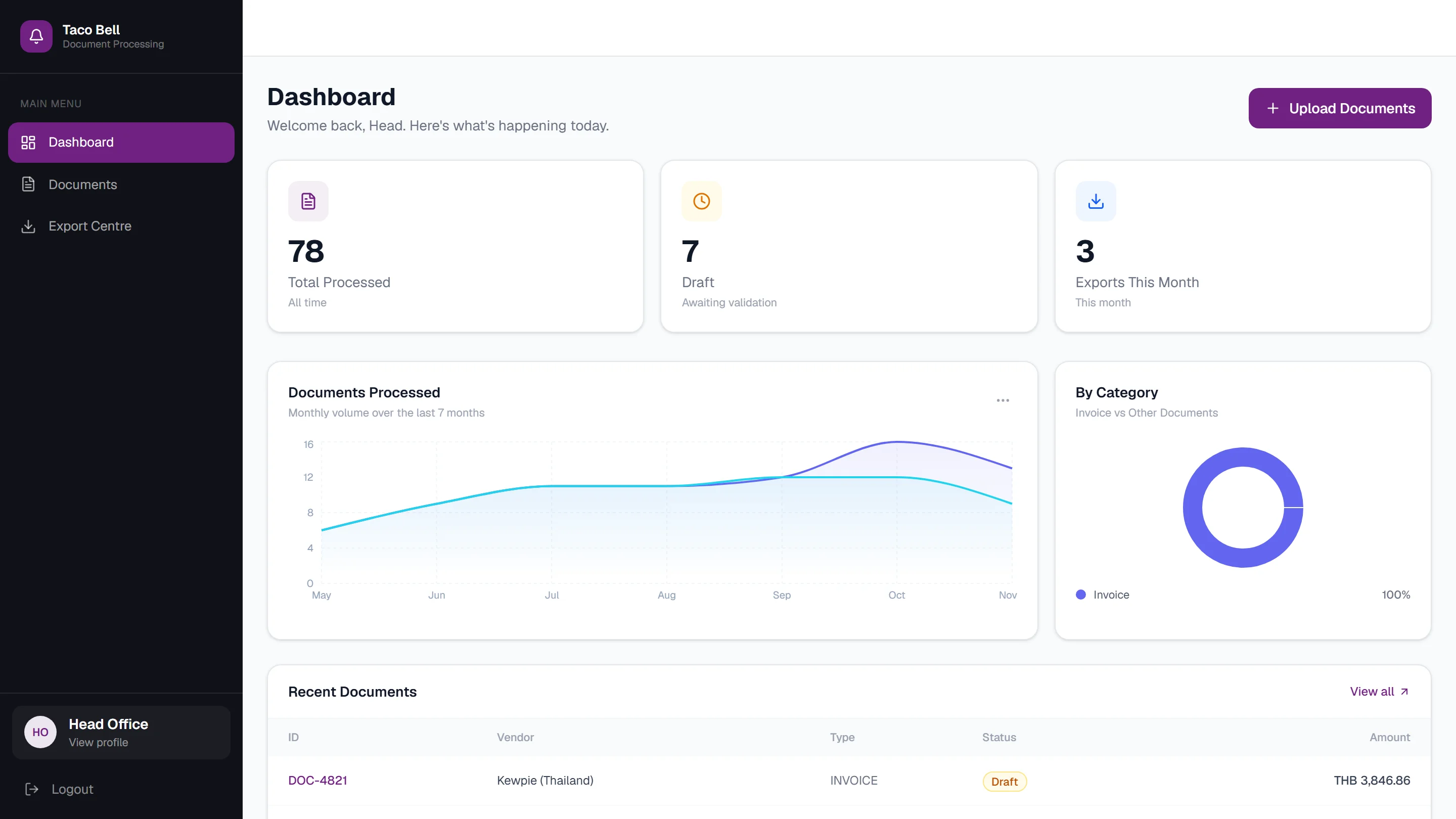
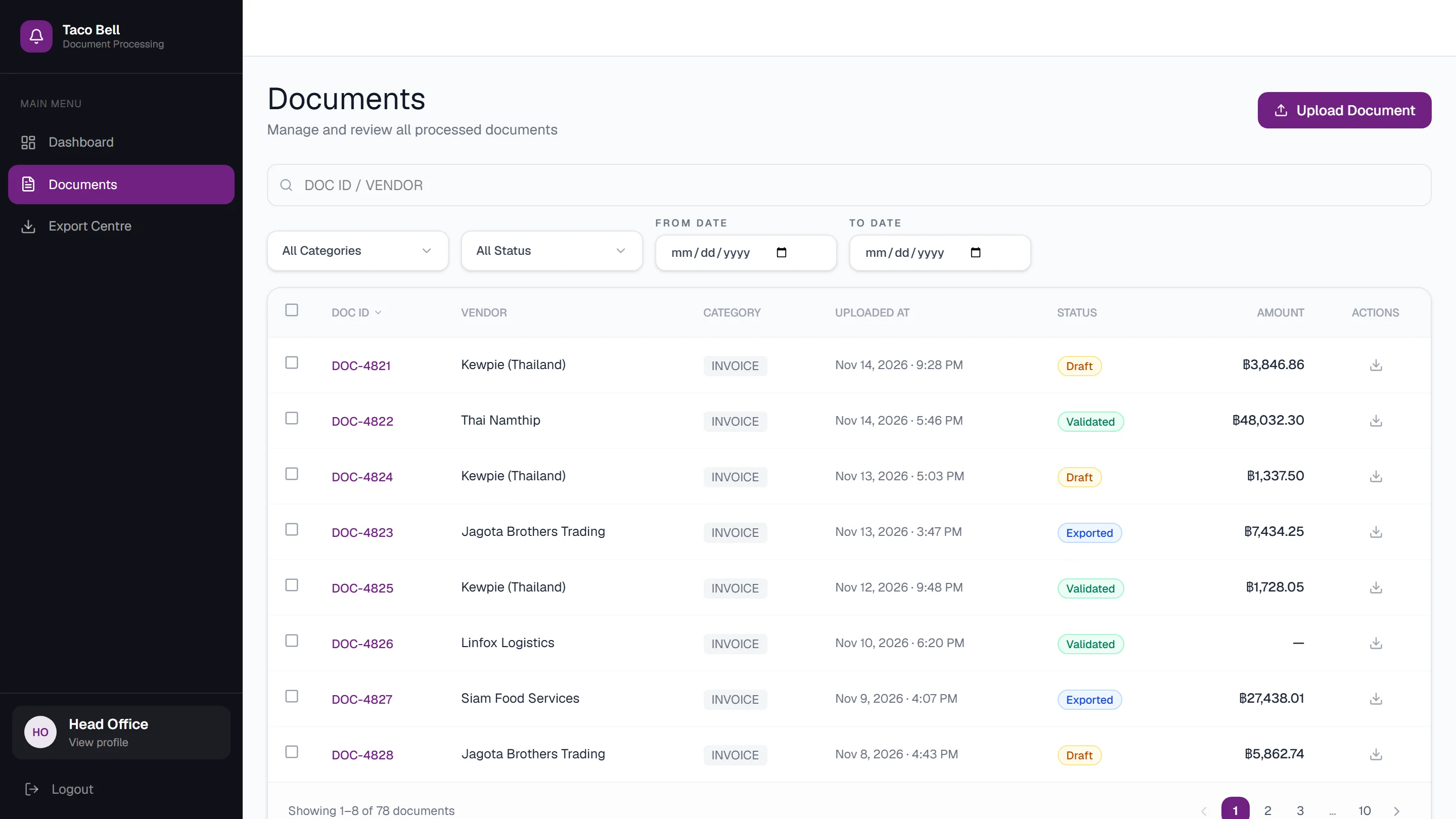
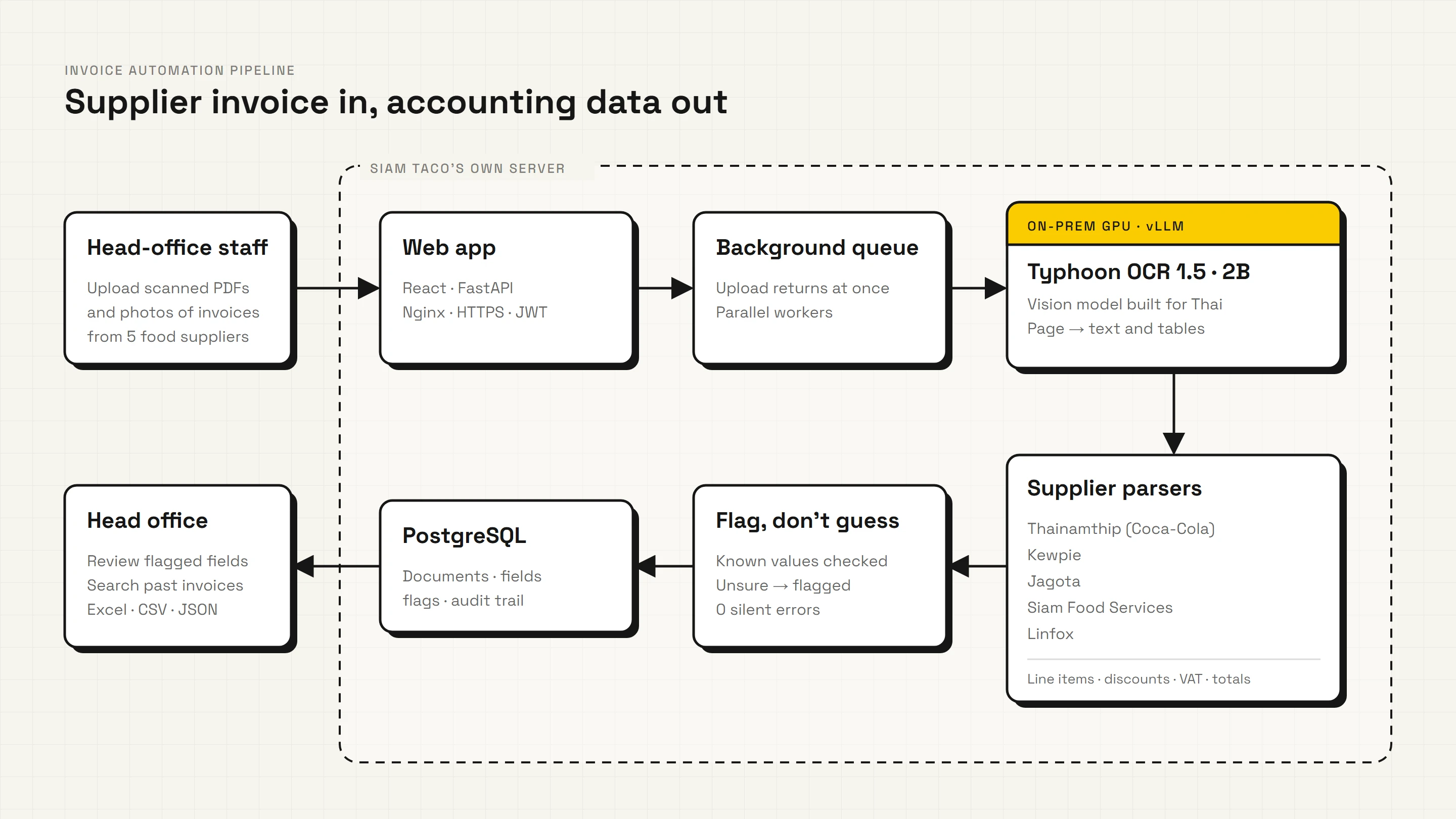
Staff upload a scanned PDF or photo and pick the supplier. About 25 seconds later they get the whole invoice as data: header, branch, every line item with its discount, VAT and totals. Anything the system isn't sure of is flagged for review. Every invoice is stored and searchable, and exports to Excel, CSV or JSON. There's a template for each of Taco Bell's five food and beverage suppliers: Thainamthip (Coca-Cola), Kewpie, Jagota, Siam Food Services and Linfox.
The problem it solves
Siam Taco runs more than 30 Taco Bell branches. Five suppliers deliver to them and send their invoices to head office, where staff have to turn each one into an accounting record. The invoices mix Thai and English, every supplier lays them out differently, and one wrong Thai character makes a value wrong. Generic AI extraction makes it worse by inventing confident values, and in finance a made-up number is worse than a blank. The data also had to stay inside the company's network.
My role
I led it end to end at Credentech: the approach, the OCR pipeline, the supplier parsers, the evaluation, the hardware sizing and the deployment. Two developers helped with parts of the interface and the on-prem hardening.
Architecture and decisions
OCR plus rules, with no language model guessing. An early version used a 30B language model to structure the OCR text. It invented values and couldn't fit on the client's hardware, so I removed it. Now Typhoon OCR, a 2B vision model built for Thai, reads each page, and a parser for each supplier maps it onto one shared schema.
Flag, don't guess. A value shown without a flag has to be right. Known supplier details are treated as expectations, never silently overwritten, and anything that disagrees with them is flagged.
On the client's own server. The model runs on vLLM on one GPU at head office, and the cloud path was removed from the code. A background queue takes the uploads, so staff can drop in a day's invoices and keep working. FastAPI, PostgreSQL and React run in Docker behind Nginx and HTTPS.
Engineering challenges
Measuring honestly. I built the answer key by reading every test invoice by eye, scored by exact match, and kept separate held-out sets so the numbers couldn't flatter the parsers. The target that mattered most was zero silent errors.
Model quirks. The local model sometimes looped on empty table rows, so I stream its output and cut the repetition. Reading rotated Kewpie pages both ways took that supplier from 89.5% to 95.8%, and greedy decoding lifted Thainamthip from 73% to 96% of values found.
Sizing the hardware. The model's speed is limited by GPU memory bandwidth, so I estimated each candidate card from its bandwidth. That ruled out cards that looked big enough on paper, including the cloud L4, and set the spec at an RTX 5070 Ti.
Results
96% field accuracy on 121 hand-checked invoices, exact match, ahead of the vendor's own cloud API at 94%, and 97.7% on line items and money.
0 silent errors, with only 2.4% of fields flagged for review.
~25 seconds an invoice and ~200 an hour under load, deployed on Siam Taco's own server.
How it helps Siam Taco
Head-office staff stop keying invoices. They check only the two or so fields in every hundred the system flags and trust the rest. Every invoice is matched to its branch and stays searchable, supplier billing can be checked against what each branch received, and the financial data never leaves the building.